
For most of the last two decades, a single physical product got classified twice — by two different teams, in two different tools, against two different rulebooks, often describing the same item in two different ways.
The import side assigned an HS/HTS code to figure out duties. The export side assigned an ECCN to figure out licensing. The two rarely talked. One product, two parallel universes, no shared source of truth — and a quiet pile of reconciliation work nobody wanted to own.
In 2026, a growing number of trade compliance teams stopped tolerating that. Not because the two classification systems merged — they didn’t, and they can’t — but because running them as two disconnected workflows was never actually necessary. This guide explains what changed, what unification really means (and doesn’t), and what to look for if you’re tired of classifying the same SKU twice.
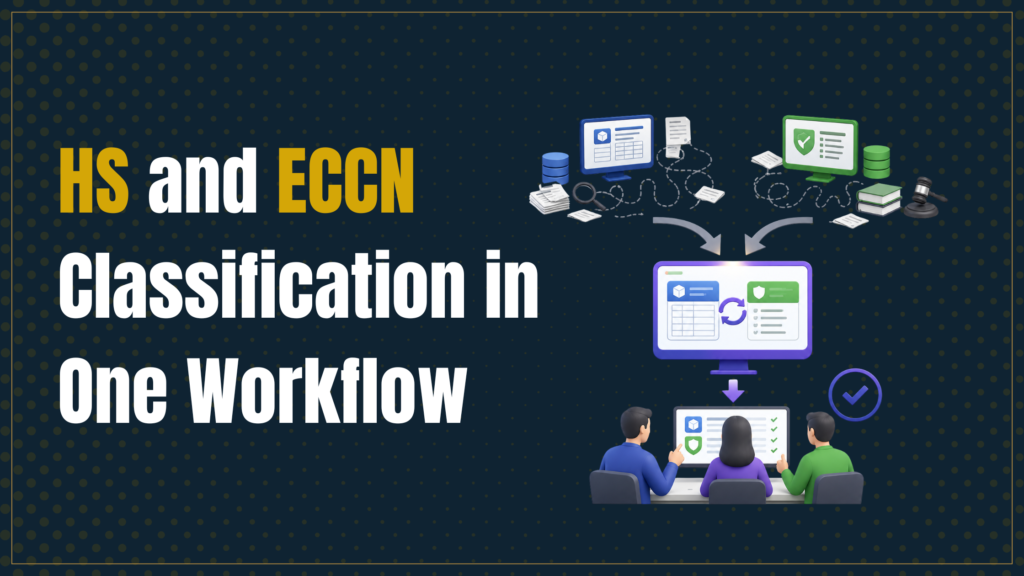
The short version: HS and ECCN remain distinct classification systems with distinct logic. What teams unified is the workflow around them — one product master, one source of spec data, parallel determinations, and a single audit trail — so the same item isn’t described, keyed, and reasoned about twice.
Two systems, one product: a quick refresher
The reason these stayed separate so long is that they genuinely answer different questions. It’s worth being precise, because the unification argument only holds if you respect the differences.
| HS / HTS classification | ECCN classification | |
| Question it answers | What duty do I pay to import this, and under what trade rules? | May I export this, and to whom — with or without a license? |
| Governing system | Harmonized System (WCO), localized as HTS / CN / ITC-HS, etc. | Commerce Control List (CCL) under the EAR |
| Authority | National customs administrations; WCO sets the global 6-digit base | Bureau of Industry and Security (BIS), U.S. Dept. of Commerce |
| What it controls | Tariffs, duties, trade-agreement eligibility, import requirements | Export licensing, destination/end-use/end-user restrictions |
| Code form | 6-digit HS base, extended nationally (8–10 digits) | 5-character alphanumeric (e.g. 3A001), or EAR99 |
| Direction | Inbound | Outbound |
BIS is explicit that an ECCN is distinct from and entirely unrelated to a Schedule B number or an HTS code. So nobody is claiming the codes are interchangeable. (For the structure of each, see the anatomy of an HS code and our free ECCN tool guide.)
And yet — both classifications start from the exact same place: a real product with a real spec sheet. That shared starting point is the entire basis for unifying the workflow.
The hidden cost of running two systems
The two-system model rarely fails loudly. It bleeds you slowly, in five predictable ways:
1. You describe the same product twice. The import team writes one product description to find the HTS code; the export team writes another to find the ECCN. Same item, two descriptions, two interpretations of “what this thing actually is.” That divergence is the root of most downstream pain.
2. Your product master data drifts. When the two descriptions live in two tools, they drift apart over time. Now you have a SKU that is, on paper, two slightly different products — and an auditor who can see it.
3. You pay a reconciliation tax. Schedule B (export statistics), HTS (import), and ECCN (export control) are three different numbers for one item, frequently maintained by different people in different spreadsheets. Keeping them consistent is unglamorous, never-ending work.
4. Expertise gets siloed — and so does key-person risk. The person who really understands your import classifications and the person who understands your export classifications are often not the same person, and neither documents in a way the other can use. When one leaves, knowledge walks out the door twice.
5. Audits become archaeology. When a customs or BIS question lands, you’re not retrieving one clean record — you’re stitching together two systems that were never designed to agree. Defensibility suffers exactly when you need it most. (This is the opposite of the audit-ready posture every shipment should have.)
None of these is catastrophic on a Tuesday. All of them compound across tens of thousands of SKUs and several years.
Pick a time on the calendar that loads next — no email back-and-forth.
The insight that made unification obvious
Here’s the structural point that took the industry a while to act on: both HS and ECCN classification are the same kind of problem.
Neither is really a lookup. Both are reasoning-from-product-attributes problems. You take the same inputs — what the item is made of, what it does, its technical parameters, its function — and you reason toward a code:
- For HS/HTS, you reason through the General Rules of Interpretation, headings, and notes toward a tariff heading.
- For ECCN, you reason through the CCL Order of Review — category, product group, specific entry, technical thresholds — toward a control number or EAR99.
Different rulebooks, same cognitive shape, and — critically — the same source data feeds both. The spec sheet that tells you a device’s frequency and output power is the spec sheet that drives both the tariff heading and the ECCN entry.
Once you see that, two separate data-entry pipelines look like what they are: redundant. You shouldn’t have to tell two systems what the product is. You tell one system what the product is, and it produces both determinations — each with its own reasoning, each defensible on its own terms.
What “one workflow” actually means (and what it doesn’t)
Let’s be careful here, because this is where credibility is won or lost.
Unifying does NOT mean:
- Merging the codes (you can’t — HS and ECCN are different systems).
- One blended “answer” that mushes import and export logic together.
- Skipping the distinct review process each system requires.
Unifying DOES mean:
- One product master. A single, canonical description of each item — entered once, used everywhere.
- One source of spec data. The technical attributes that drive both determinations live in one place.
- Parallel, independent determinations. The HTS classification and the ECCN classification each run their own proper logic — but from shared inputs, in the same tool, at the same time.
- One audit trail. Both classifications, both rationales, retained together against the same SKU — so a customs question and a BIS question both pull from the same clean record.
- One integration surface. A single API or spreadsheet integration instead of two systems your ERP has to reconcile.
The classification logic stays separate, as it must. The workflow, data, and evidence become one. That’s the whole idea — and it’s why the title says teams stopped using two systems in the operational sense, not that the two regimes stopped existing.
Why 2026 was the year teams finally unified
The two-system model survived for years because it was merely annoying. Three forces in 2026 turned it from annoying into untenable — all at once.
1. Import-side volatility. Tariff schedules and trade rules have been moving fast — shifting duty rates, de minimis changes, new trade measures. When your import classifications need constant re-checking, a slow, siloed import workflow is a liability.
2. Export-side expansion. BIS has steadily widened export controls, especially around advanced computing, semiconductors, and AI. Items that were comfortably EAR99 a couple of years ago now carry controlled ECCNs. Suddenly the export-classification workload is bigger and higher-stakes than it used to be. (We’ve written about that trajectory in The New Iron Curtain Is Made of Silicon.)
3. Volume plus AI. Catalogs have grown into the tens and hundreds of thousands of SKUs, well past what two manual teams can re-classify by hand. At the same time, classification tooling got good enough to reason from product descriptions at scale — making a unified, bulk HS+ECCN workflow genuinely feasible for the first time, not just desirable.
Put those together: more import churn, more export risk, more SKUs, and finally the tooling to handle both in one place. The teams that unified didn’t do it for elegance. They did it because doing the same work twice, slowly, in two systems, stopped being survivable.
How a unified HS + ECCN workflow runs in practice
The operating model is simpler than the two-system one it replaces:
- Onboard the product once. Capture the description and technical specs in a single product record.
- Run both determinations from the same inputs. The system produces a candidate HTS classification and a candidate ECCN (or EAR99) — each with its own transparent reasoning.
- Review the exceptions, not everything. Obvious cases (a plain commodity that’s clearly EAR99 and an unambiguous tariff heading) clear fast; the tool surfaces the items near a tariff edge or a control threshold for human attention.
- Sign off with a human on the hard cases. This is non-negotiable and it’s the same on both sides — software does the heavy lifting and shows its work; a person owns the final call on anything sensitive.
- Retain one combined record. Both codes, both rationales, one audit trail, against one SKU.
- Re-check on change. When a tariff schedule shifts or BIS revises the CCL, you re-run from the same product master instead of chasing two separate spreadsheets.
Notice that the human-in-the-loop, audit-ready principle doesn’t get diluted by unification — it gets applied consistently across both classifications instead of differently in each silo.
What to look for in HS + ECCN classification software
If you’re evaluating a unified platform, here’s a buyer’s checklist that separates real unification from a bolted-together demo:
- One product master, two determinations. Enter the item once; get both HTS and ECCN reasoning. If you’re re-keying the product for each, it isn’t unified.
- Transparent reasoning on both sides. Every code should come with a rationale you can check — for tariffs and for export control. Reasoning is what makes a classification defensible.
- Audit-ready records by design. A retained, exportable trail for each determination — not a disposable answer on screen.
- Human-in-the-loop, not autopilot. The system should flag thresholds and ambiguities for review, never quietly auto-finalize sensitive items.
- Scales from one to many. A single lookup and a 200,000-row catalog should run through the same engine — via bulk upload or API.
- Current data, re-checkable. Classifications you can re-run against the latest tariff schedules and the current CCL, because both move.
- Honest about its limits. No tool replaces a binding BIS CCATS determination or qualified counsel on the genuinely hard cases. A platform that pretends otherwise is the one to avoid.
That last point matters as much as the feature list. The value of unification is consistency and defensibility — which evaporates the moment a tool overclaims.
Frequently asked questions
Can HS codes and ECCNs be combined into one code? No. They are separate systems governed by different authorities for different purposes — import duties vs. export control. What you unify is the workflow (one product master, shared data, parallel determinations, one audit trail), not the codes themselves.
Why would a trade team use one system for both? To stop describing and classifying the same product twice. A unified workflow gives you a single source of truth, consistent product data across import and export, faster classification at scale, and one clean audit trail instead of two systems that have to be reconciled.
Is the classification logic the same for HS and ECCN? No — and a good tool keeps them distinct. HS classification follows the General Rules of Interpretation toward a tariff heading; ECCN classification follows the CCL Order of Review toward a control number or EAR99. They share inputs (the product and its specs), not rules.
Does unifying mean skipping the proper review process? It shouldn’t. Each determination still runs its own correct logic and still needs human sign-off on sensitive or borderline items. Unification removes duplicate data entry and reconciliation — not diligence.
What’s the difference between a Schedule B number, an HTS code, and an ECCN? Schedule B is used to report export statistics; HTS governs import duties; an ECCN governs export control licensing. One product can have all three, which is precisely why maintaining them in separate systems gets messy.
Can a unified tool handle large product catalogs? Yes — the practical driver for unification is volume. Look for a platform where the same engine runs a single classification or a six-figure SKU catalog through bulk processing or an API.
Pick a time on the calendar that loads next — no email back-and-forth.
The honest bottom line
HS and ECCN classification will always be two different disciplines. That’s not changing. What changed in 2026 is that trade teams stopped accepting two disconnected systems as the price of doing both — because the work shares the same starting point, the same source data, and the same need for defensible, audit-ready reasoning.
One product master. Two determinations, each done properly. One audit trail. Human sign-off where it counts. That’s not a compromise between import and export compliance — it’s the version of the job that was always possible once the tooling caught up.
TariffWolf was built for exactly this: tariff (HS/HTS) and export control (ECCN / EAR / dual-use) classification in one workflow, with reasoning you can check and a record you can defend.
Don’t take our word for it. Don’t Trust Us. Try Us.
This article is for general information and is not legal advice. For determinations on specific items, consult the current HTS and EAR, file a CCATS request with BIS where appropriate, or speak with qualified trade compliance counsel.