
Most export violations don’t come from companies trying to break the rules. They come from busy shipping teams who missed something — a customer name that should have been screened, a product whose classification was never confirmed, a destination country that quietly slipped onto a sanctions list. The fines don’t care about intent. A clerk who hits “ship” on an order to the wrong end user can trigger a violation that costs the company millions and lands it on a published enforcement list for years.
The good news is that most violations are catchable with a short, repeatable set of checks done before the shipment leaves the dock. You don’t need to be a full-time compliance officer to run them. You need a checklist, a small amount of training, and the discipline to apply the same five steps to every export, every time.
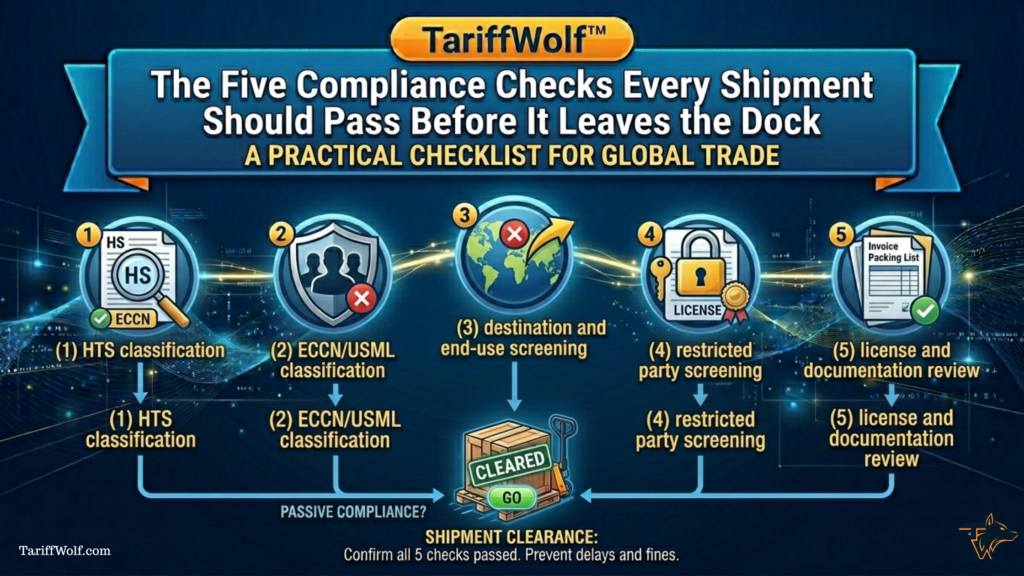
Here are those five checks, in the order they make the most sense to perform.
Check One: HTS Classification
Every product crossing a U.S. border needs a Harmonized Tariff Schedule code — a ten-digit number that tells Customs what the product is, what duty it owes, and what reporting categories it falls into. The HTS classification determines the tariff line, eligibility for trade preference programs, and the statistical reporting that flows through to the Census Bureau.
Getting it wrong has real consequences. An incorrect classification can mean underpaid duties (which Customs will eventually claw back, often with penalties), missed eligibility for free trade agreement benefits, or a flagged entry that delays the whole shipment. On the export side, the equivalent code is the Schedule B number, and it feeds into the Electronic Export Information filing in the Automated Export System.
The pre-shipment check is straightforward: does every line item on the commercial invoice have a verified HTS or Schedule B code, and is that code documented somewhere your team can defend if asked? “We’ve always used this code” is not a defense. “Here’s the classification analysis our trade specialist signed off on in March” is.
Check Two: ECCN or USML Classification
The HTS tells Customs what the product is for tariff purposes. The export control classification tells the State and Commerce Departments what the product is for national security purposes. They are separate questions with separate answers, and a shipment can clear one and fail the other.
If the product is a defense article — anything on the U.S. Munitions List — it falls under ITAR jurisdiction and the Directorate of Defense Trade Controls. If it’s a commercial or dual-use item, it falls under EAR and needs an Export Control Classification Number, or ECCN, drawn from the Commerce Control List. If it’s an EAR item that isn’t specifically listed, it gets the catch-all designation EAR99.
Before shipping, your team should know which regime applies and what the specific ECCN or USML category is. That single piece of information drives everything that follows: whether you need a license, which destinations are restricted, which end uses are off-limits, and how the shipment must be documented. Skip this step and the rest of the checks have nothing to anchor to.
Pick a time on the calendar that loads next — no email back-and-forth.
Check Three: Destination and End-Use Screening
A product that ships freely to one country may be completely prohibited to another. The U.S. maintains comprehensive sanctions against several countries — including Cuba, Iran, North Korea, Syria, and the Crimea, Donetsk, and Luhansk regions of Ukraine — and more targeted controls against many others. Beyond country-level sanctions, certain end uses are prohibited regardless of destination: missile technology proliferation, chemical and biological weapons development, and unsafeguarded nuclear activities, among others.
The destination check has two parts. First, where is the shipment physically going? Cross-reference that country against the comprehensive sanctions list and against the Country Chart in the EAR, which tells you whether your specific ECCN requires a license to that destination. Second, what is the customer going to do with the product? End-use controls under EAR Part 744 can pull an otherwise license-free shipment back into the licensing requirement if there’s reason to believe the product will be used in a prohibited way.
This is also where “red flags” enter the picture — circumstances that should make you pause even when nothing on a list lights up. A customer who refuses installation services for equipment that normally requires them, a freight forwarder who asks for unusual routing, a request to ship to a freight-forwarder address rather than the actual end user, or a buyer whose stated business has nothing to do with what they’re ordering. Red flags are not violations on their own, but they are the moment to stop and ask another question rather than push the shipment out.
Check Four: Restricted Party Screening
Every party to a transaction needs to be screened against U.S. government denied and restricted party lists. That means the customer, the end user, the consignee, the freight forwarder, the bank, and any other entity named on the paperwork. The relevant lists include the OFAC Specially Designated Nationals (SDN) list, the BIS Entity List, the BIS Denied Persons List, the Unverified List, the Military End User list, and the State Department’s debarred parties list, among others.
Doing this manually, list by list, is tedious and error-prone. Most companies use a screening tool — either a standalone service or a module inside their ERP, TMS, or trade compliance platform — that consolidates the lists and runs the names automatically. The screening should happen at the point of order entry, again before shipment, and ideally on a periodic refresh for ongoing customers, because lists change and a customer who was clean last quarter might not be this quarter.
The screening should be documented. A printout, an electronic record, a timestamped log entry — something that proves the check was run, by whom, and what result it returned. If a name comes back as a possible match, the shipment stops until a qualified person reviews and clears the hit.
Check Five: License and Documentation Review
The final check ties everything together. Given the classification, the destination, the end use, and the parties involved — does this shipment require an export license, and if so, has one been issued? Does the documentation match what the regulations require?
For ITAR shipments, this means a DDTC-issued license or an applicable license exemption, plus the supporting documentation the exemption requires. For EAR shipments, it means a BIS license, a license exception (such as TMP, RPL, or LVS), or a determination that no license is required for this combination of ECCN and destination — usually documented as “NLR” on the export paperwork. The Electronic Export Information filing in AES needs to reflect the correct values: ECCN, license type, license number or exception code, country, and value.
Beyond export control documents, the shipment needs the routine paperwork to be accurate and consistent: commercial invoice, packing list, bill of lading or air waybill, certificates of origin where applicable, and any product-specific documentation like material safety data sheets or end-use certificates. Inconsistencies between documents — a value on the invoice that doesn’t match the AES filing, a description on the packing list that doesn’t match the HTS classification — are exactly what triggers customs holds and audits.
Making the Checklist Stick
The five checks are simple in concept and unforgiving in practice. The companies that run them well don’t rely on memory. They build the checklist into the shipping workflow, require sign-off before release, and conduct periodic spot audits to make sure the checks are actually being performed and not just clicked through.
Compliance is not an extra step layered on top of shipping. Done right, it is shipping — the part that keeps the goods moving, the customers happy, and the company’s name off the wrong kind of government list.