
TariffWolf puts HS classification inside the spreadsheet, as an add-on formula called =TWHSCODE, because in nearly a decade of classifying I never met a classifier who worked without a spreadsheet open next to their “real” tool. This is how that observation became the product.
It was 2017. I was sitting at my desk on my first real day in trade compliance, staring at a screen full of product descriptions, six-digit codes and a tariff schedule that seemed to stretch into infinity.
I had no idea that, nearly a decade later, I would have classified close to one million commodities: by hand, by tool, by every system imaginable, across some of the most demanding industries on the planet.
I’m Surajit Roy, Co-Founder of TariffWolf. What follows is the story of how that decade of work shaped what we are building today, and why we believe HS classification belongs inside a spreadsheet.
A decade across industries
Over those years, my work took me through worlds that, on the surface, had nothing in common.
I classified products for an e-commerce giant where catalogs grew faster than anyone could keep up with. I worked inside one of the world’s top internet companies, where every shipment had to clear customs across dozens of jurisdictions. I sat with automobile manufacturers untangling part numbers that read like a foreign language. And I worked with one of the oldest freight forwarding services in the trade, where compliance was a craft passed down across generations.
The industries, the stakes and the tools were all different.
Some companies had built proprietary classification systems from the ground up. Others relied on the well-known names: the GTS, the GTM, the enterprise platforms that promise to do everything. Each one had its own interface, its own logic, its own learning curve and its own quirks.
But one strange thing kept showing up, and it nagged at me for years.
Pick a time on the calendar that loads next — no email back-and-forth.
The spreadsheet that refused to leave
No matter which company I joined, no matter how sophisticated the in-house tool, no matter how many millions had been spent on the latest enterprise platform, every classifier I met (including me) always had a spreadsheet open on the side.
The expensive tool would be running in one window. The spreadsheet would be running in the other.
Why?
Because spreadsheets are how classifiers actually think. We compare, sort, filter, bulk-edit and track exceptions. We slice data sideways to spot patterns the “official” tool was never built to show us.
The enterprise systems were where the data lived. The spreadsheet was where the work happened.
That observation became the seed of everything we are building today.
What is =TWHSCODE?
=TWHSCODE is the TariffWolf spreadsheet formula that returns an HS code for a product description. It came out of one question: if the spreadsheet is where the work already happens, why are we forcing classifiers to leave it?
That question became the foundation of TariffWolf. So we built classification intelligence that lives inside the spreadsheet itself, with no other platform to log into and no other tool to learn. It works through a single formula:
=TWHSCODE (‘Product Description’,’Country of Destination’)
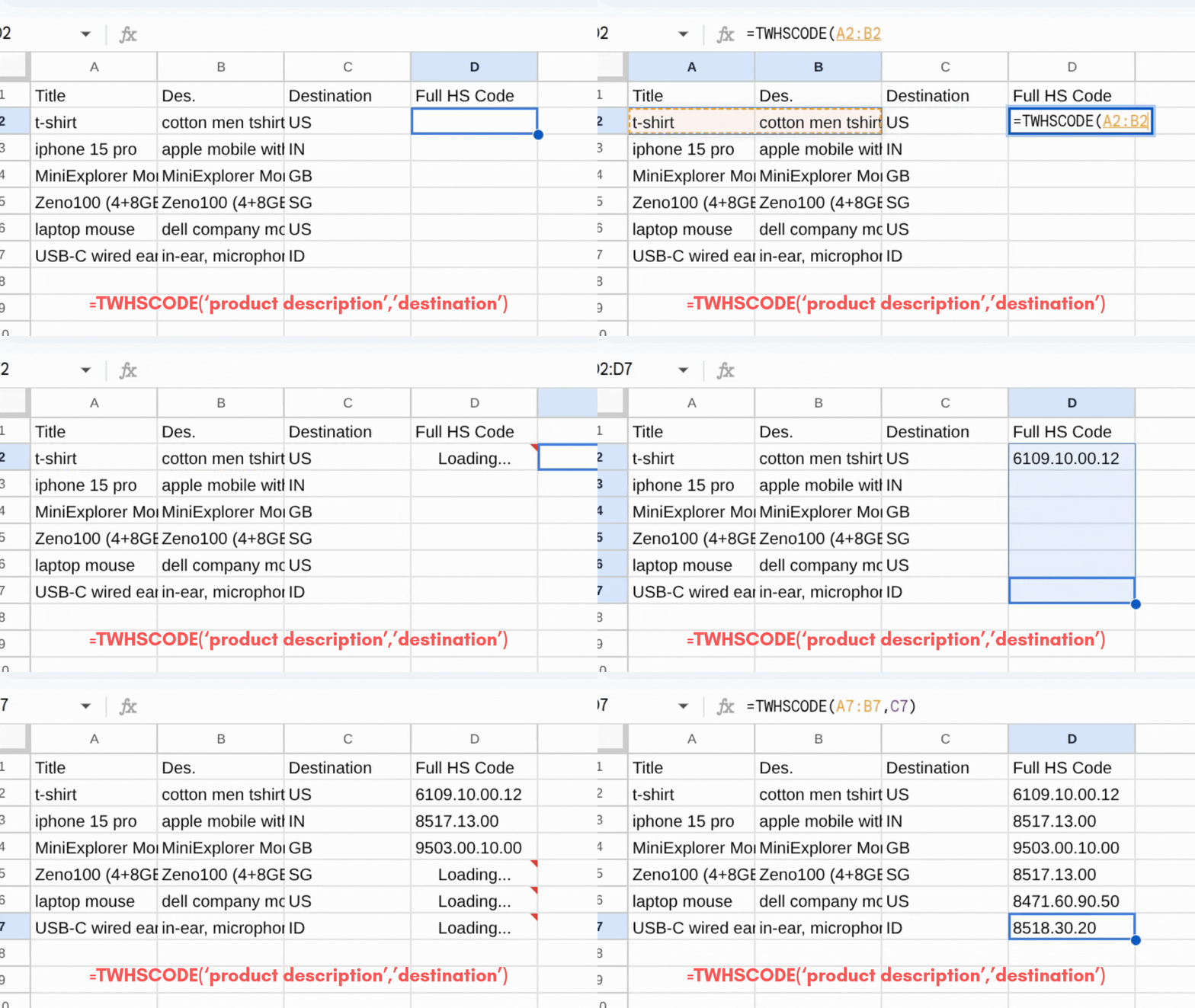
Type it in a cell. Pass in your product description. The HS code appears next to it.
That is the whole workflow, and the entire learning curve.
How is =TWHSCODE different from VLOOKUP?
=TWHSCODE classifies a product; VLOOKUP only retrieves a value you already have. I want to be very clear on this, because it is the most important part.
Traditional spreadsheet formulas like VLOOKUP, XLOOKUP and INDEX/MATCH are lookup systems. They find a value that already exists in a table you have prepared. They are powerful, but passive: they retrieve values that are already there.
=TWHSCODE is not a lookup formula. It is classification intelligence, delivered through the spreadsheet interface. When you call it on a product description, we read the description, understand the commodity, weigh it against the structure of the Harmonized System (the international product nomenclature that HS codes come from), and return the code that fits. Nothing is looked up from a static table on your sheet.
This is the distinction that defines us:
“Traditional formulas look things up. TariffWolf classifies.”
A lookup needs a pre-built answer key; classification intelligence works without one. It works the way an experienced human classifier works, except it does it at the pace of a formula recalculation.
Is TariffWolf a GTM or GTS platform?
No. TariffWolf is not a traditional Global Trade Management (GTM) or Global Trade Services (GTS) platform. We are not asking you to migrate your data, restructure your processes, run a six-month implementation or train your team on yet another dashboard.
We are classification intelligence for global trade compliance: a focused, specialized product built around the single hardest problem in the workflow (getting the HS code right) and delivered in the place classifiers already trust.
The big GTM and GTS systems try to do everything. We do one thing, and we do it where the work actually happens.
How fast is classification in the spreadsheet?
=TWHSCODE classifies roughly 10 items per minute. Once the add-on is installed, classification stops being a project and becomes a function, literally. You write =TWHSCODE the way you’d write SUM, and the HS code appears in the cell next to your product description.
Multiply that across a catalog, a team and a year. The hours saved aren’t small; they are the difference between drowning in a classification backlog and having time to think about the harder calls, the edge cases and the exceptions that need human judgment.
And because it lives inside the spreadsheet your team already knows, there is nothing to relearn. For a professional who changes organizations every few years (and most of us do), that is freedom.
Built by classifiers, for classifiers
We built TariffWolf from a million rows of frustration. From a decade of switching companies and re-learning tools that never quite fit the way the work happens. From watching brilliant classifiers spend their first month at a new job clicking through onboarding wizards instead of doing the job they were hired to do.
If you have ever kept a spreadsheet open next to your “real” classification tool, you already understand why we exist.
TariffWolf is the tool we wished someone had built ten years ago.
So we built it.
Welcome to classification intelligence that finally lives where you do.
Frequently asked questions
How do I use =TWHSCODE in a spreadsheet?
Once the TariffWolf add-on is installed, type =TWHSCODE in a cell and pass in the product description and the country of destination. The HS code appears in the cell, next to the product description. You write it the way you would write SUM.
Can a spreadsheet formula classify HS codes without a lookup table?
Yes. Lookup formulas such as VLOOKUP, XLOOKUP and INDEX/MATCH need a table of answers you have already prepared. =TWHSCODE needs no answer key: it reads the product description, works out what the commodity is, weighs it against the structure of the Harmonized System and returns the code that fits.
How many products can =TWHSCODE classify per minute?
TariffWolf puts the speed of =TWHSCODE at roughly 10 items per minute. The time saved goes to the harder calls, edge cases and exceptions that need human judgment. For whole catalogs or classification inside other systems, see our comparison of bulk and API classification.
Do I need a data migration or implementation project to use TariffWolf?
No. TariffWolf is not a GTM or GTS platform, so there is no data migration, process restructuring, six-month implementation or new dashboard to learn. It runs inside the spreadsheet your team already uses. For how one of the other TariffWolf formulas performed on its own, read our audit of AI classification with no human review.
— Surajit Roy, Co-Founder, TariffWolf