
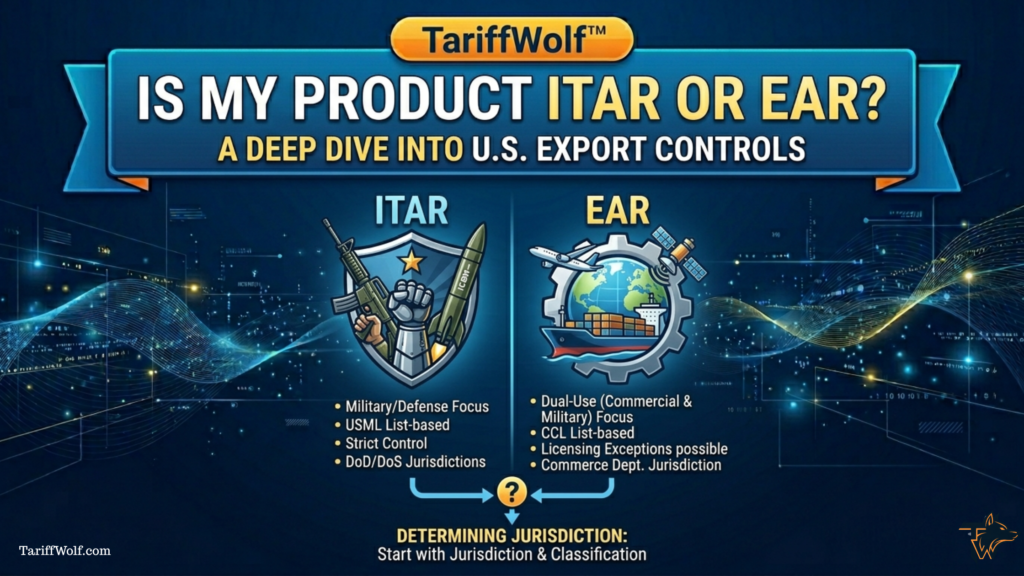
The first time a U.S. company tries to ship something overseas that has any conceivable defense application, they run into a question that can stop the shipment cold: is this product controlled under ITAR or EAR? The answer determines which agency regulates the export, what license you need, how long approval takes, and what penalties apply if you get it wrong. And the penalties are not theoretical — civil fines can run into the millions per violation, and criminal cases have ended careers.
Here’s a practical framework for thinking through that question before you ever pack a crate.
Two Regimes, Two Agencies, Two Lists
U.S. export controls split the universe of regulated items into two camps.
The International Traffic in Arms Regulations (ITAR) governs defense articles and defense services. ITAR is administered by the Directorate of Defense Trade Controls (DDTC), which sits inside the State Department. The list of items ITAR covers is called the U.S. Munitions List, or USML, and it’s organized into 21 categories — firearms, ammunition, launch vehicles, military electronics, military training, and so on.
The Export Administration Regulations (EAR) govern dual-use items — things with both commercial and military applications — along with purely commercial goods, software, and technology that nonetheless warrant some level of export oversight. EAR is administered by the Bureau of Industry and Security (BIS), part of the Commerce Department. Its list is the Commerce Control List, or CCL, organized into ten categories that mirror many of the technical fields the USML touches but at a generally lower level of military sensitivity.
The shorthand most exporters use: USML/ITAR for weapons and items built specifically for military use, CCL/EAR for almost everything else that’s still subject to export rules, including a lot of dual-use technology.
Start With the USML
The decision framework begins on the ITAR side, not the EAR side, and the order matters. If a product is on the USML, it’s ITAR-controlled, full stop — EAR doesn’t enter the picture. So your first job is to walk through the 21 USML categories and ask whether your product is described by any of the entries.
Some categories are easy. If you’re shipping a fighter jet engine, a missile guidance set, or military-grade body armor, you’re squarely on the USML. Other categories are subtle. Category XI covers military electronics. Category XV covers spacecraft and related articles. Category VIII covers aircraft and their parts. The descriptions inside each category are technical, and sometimes a part that seems commercial — a bolt, a connector, a piece of software — falls under USML coverage because of how it was designed or what it was designed for.
If nothing on the USML describes your product, the default is EAR. The EAR’s jurisdictional reach is broad — it claims authority over all items “subject to the EAR,” which includes most U.S.-origin commercial goods even when they’re not on the CCL.
Pick a time on the calendar that loads next — no email back-and-forth.
The “Specially Designed” Test
The trickiest part of USML classification is a phrase that appears throughout the list: specially designed. A part, component, accessory, attachment, or software module can land on the USML if it was specially designed for a defense article — even if, on its own, the part looks ordinary.
The regulations spell out a multi-step “catch and release” test. First, the catch: did the item result from development for, or have properties peculiar to, a defense article? Second, the release: there are several enumerated escapes — for example, if the item has the same function, performance capabilities, and form and fit as a commercial item, or if it was developed with knowledge that it would be used in both defense and non-defense applications and has the same function as a non-defense item.
The specially designed test is where exporters most often get tangled up. A bracket inside an aircraft might be ITAR if it was engineered specifically for an F-35 and has no commercial equivalent. The same bracket might be EAR if it was originally developed for a commercial airliner and later adapted for military use. The history of the part — who designed it, for what program, and with what knowledge — matters as much as the part itself.
Commodity Jurisdiction Requests
When the analysis is genuinely close — when reasonable engineers and trade-compliance lawyers could disagree about whether something belongs on the USML — there’s a formal mechanism to get an answer from the government. It’s called a Commodity Jurisdiction (CJ) request.
You file a CJ with DDTC. DDTC reviews it in consultation with Commerce and Defense, and issues a determination: this product is ITAR, or this product is EAR. CJ determinations take time — often several months — but they give you a written answer you can rely on. For a company building a new product line, especially one that draws on military heritage technology being repurposed for commercial markets, a CJ is often the cleanest way to nail down jurisdiction before sales conversations turn into shipments.
Commerce has a parallel process called a Commodity Classification Request (CCATS) that operates inside EAR — it tells you which Export Control Classification Number (ECCN) on the CCL applies to your item. CCATS doesn’t determine ITAR-versus-EAR jurisdiction; it tells you where on the EAR side your item sits, assuming EAR jurisdiction is already established.
When a Product Has Both Military and Commercial Applications
Dual-use is the hardest case, and it’s the case most first-time exporters actually face. A drone designed for agricultural surveying might also be useful for military reconnaissance. A high-performance camera might appear in both broadcast trucks and targeting systems. An encryption library might protect banking transactions and military communications alike.
For these products, three questions tend to drive the answer. First, what was the design intent and history? A product developed for a commercial market and never modified for defense use is far more likely to be EAR. Second, what are the technical specifications relative to the thresholds in the CCL? Many CCL entries have explicit performance levels — frequency ranges, resolution thresholds, processing speeds — above which the item is controlled and below which it isn’t. Third, who are the customers and end uses? End-use and end-user controls under EAR can pull a technically uncontrolled item back into the licensing requirement if it’s headed somewhere sensitive.
Practical Steps for First-Time Exporters
A reasonable workflow for a company facing this question for the first time looks like this. Begin with a structured technical review of the product against the USML categories, documented in writing. If the USML is clearly inapplicable, move to the CCL and identify the most specific ECCN that fits, or conclude the item is EAR99 — the catch-all designation for items subject to EAR but not specifically listed. If the USML question is close, file a CJ rather than guessing. Build a compliance file that records the analysis, the technical data sheets, the design history, and any government determinations. Screen every customer and end user against denied-party lists regardless of which regime applies.
The goal isn’t to memorize the regulations. It’s to know enough to recognize when you’re in deep water and need a specialist — and to have the documentation that shows, if anyone ever asks, that you took the question seriously from day one.