
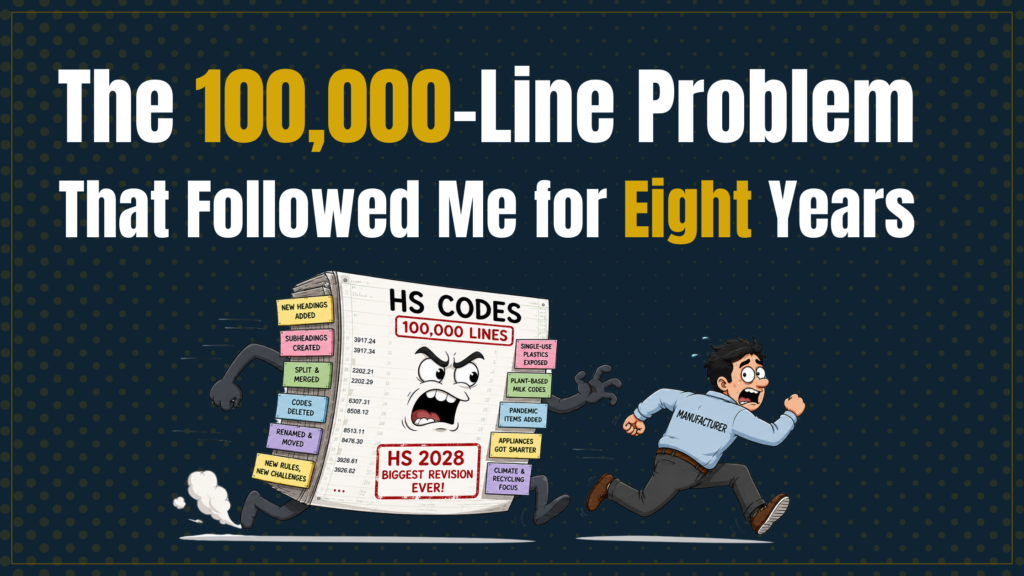
And why HS 2028 is about to hand the entire trade-compliance industry the same headache — one we’re finally built to solve.
It was January 2018. I had been a tariff classifier for exactly one month.
I was at my desk, still half-pretending I understood what I was doing, when a muffled conversation drifted across the office lobby. Something in the tone made me look up. My mentor was in the middle of it, and his face was doing that thing faces do when a deadline has just become a problem.
A few minutes later he walked over and offered me a “chai-sutta” break. He looked nervous. I followed him out, and after two or three sips of tea I finally worked up the courage to ask what the huddle had been about.
A large automobile-parts manufacturer, he told me, needed its entire item master — 100,000 lines — updated to the HS 2017 version. I blinked. “What is the 2017 version?”
So he explained the thing that would quietly define the rest of my career: every five years the World Customs Organization rewrites the Harmonized System. They add headings, delete headings, split subheadings, merge them, move goods from one code to another. The latest edition was HS 2017, and this client was still sitting on HS 2012 codes. They were already a year late. They wanted the full backlog re-classified and delivered in one week, on a spreadsheet.
We didn’t have the manpower for 100,000 lines in a week. Not even close.
Then my mentor turned to me — the one-month-old rookie — and asked, “What would you do if you were in my position?”
I had nothing. I just smiled, the way you smile when you have no idea. He understood, paid the shopkeeper, and we walked back to our desks.
The night the idea wouldn’t let me sleep
That night I lay in bed turning the problem over. One hundred thousand lines. One week. 100% accuracy. Honestly? I couldn’t find a way.
I started scrolling YouTube to switch my brain off — and instead a video switched it on. It was a generic explainer about Python, machine learning, and automation. Nothing special. But a single thought lodged itself and wouldn’t leave:
If a backlog this size could be re-classified by automation, this becomes possible.
There was just one inconvenient detail. I’m not from a tech or coding background. I had no idea how to build any of it.
The next morning I walked in to find my mentor and his team already buried in the manual classification. At lunch I shared my half-formed idea about automating the whole thing. He stopped eating. He looked genuinely surprised — then hopeful.
“Can you build it?”
“No,” I said.
His face fell. After lunch he went back to the spreadsheet, and so did the rest of the team, line by exhausting line.
That “No” stayed with me for years.
Hello — I’m Surajit Roy, Co-Founder of TariffWolf.
Fast-forward to the 2020–21 lockdown. The world was working from home, and the WCO published the HS 2022 amendments. A lot of changes at the heading and subheading level — and the moment I read them, that January 2018 afternoon flashed back in full colour.
By January 2022, every classifier I knew was scrambling to move to the new edition. This time I wasn’t a rookie watching from the sidelines. By then we had built a semi-automated classification tool. And in February and March of 2022, the orders started landing on our desks:
Backlog updates. 10,000 to 500,000 lines of items. Delivery needed in a week — sometimes less.
Different clients. Different industries. Identical pain. That’s when it clicked for good: this was never one automobile company’s problem. It is the entire industry’s problem, on a five-year timer.
So we stopped treating it as a fire to fight every five years and started treating it as a system to build.
And right on schedule, here comes HS 2028.
The WCO has done it again. The HS 2028 amendments were adopted on 26 June 2025 and enter into force on 1 January 2028. This is the largest revision in years. By the official count:
- 299 sets of amendments
- 6 new headings created
- 428 new subheadings created
- 5 headings deleted
- 172 subheadings deleted
Those numbers look tidy on paper. On a spreadsheet of half a million SKUs, they are chaos. Because the WCO didn’t just add codes — it split, merged, renumbered, and transferred goods across the nomenclature. A few real examples from the 2028 edition:
- Single-use plastics get exposed. Drinking straws now have their own codes (3917.24, 3917.34). Single-use gloves, tableware, and dozens of plastic articles in Chapter 39 are carved out from their old “other” lines — to improve transparency in the plastic trade.
- Plant-based milk grows up. Soya, oat, rice, almond, and coconut beverages move out of a single catch-all (2202.99) into brand-new subheadings 2202.21–2202.29.
- The pandemic left fingerprints. Protective face masks (6307.31/.39), face shields (3926.61), and body bags (3926.62) now have dedicated codes for emergency-supply tracking.
- Your home appliances got smarter. Robotic vacuum cleaners (8508.12) and electric toothbrushes (8509.50) split out from their parent lines on rising trade volume.
- Climate and recycling move in. Heat pumps, solar-powered portable lamps (8513.11), reverse vending machines (8476.30), biodegradable polymers like PBAT and PEF, and a fully restructured Chapter 39 for plastic waste under the Basel Convention.
- Codes vanish, too. Headings 65.01, 65.02 and 65.07 were deleted and folded into a brand-new 65.08. Low-volume subheadings across chapters were quietly retired.
If a single SKU sat on a code that was split three ways, which of the three does it belong to now? Multiply that judgment call by 100,000 lines. Then remind yourself the client wants it in a week, at 100% accuracy, dropped straight into their existing spreadsheet.
That is the exact problem that left me speechless in 2018. The difference is, in 2026, we are no longer speechless.
What we built so that “No” became “Yes.”
Today, TariffWolf runs a fully automated + human-in-the-loop classification engine built for precisely this moment. The machine does what machines are great at — reading every line, matching it against the old and new nomenclature, flagging every split, merger, deletion, and transfer at scale. Our experienced classifiers do what only humans can — resolving the genuinely ambiguous judgment calls so that the answer isn’t just fast, it’s right.
Pick a time on the calendar that loads next — no email back-and-forth.
That combination is why we can promise what felt impossible to a one-month-old rookie:
- 20x faster than line-by-line manual re-classification.
- 100% accuracy, because automation handles the volume and human experts own the edge cases.
- Plugs into your spreadsheet or any existing classification tool you already run — no rip-and-replace.
- Volume is irrelevant. 10,000 lines or 1,000,000 lines, the engine doesn’t flinch.
When HS 2028 hits and your backlog suddenly carries dead codes, the question won’t be whether it needs re-classifying. It’ll be how fast, and can you trust it. We’ve spent eight years answering exactly that.
Full circle
Sometimes I think about that boy at the desk in January 2018 — confused, smiling because he had no answer, watching a team grind through 100,000 lines by hand because there was no other way.
There’s another way now. We built it.
So before the HS 2028 deadline turns your item master into a five-year fire drill, let’s talk. Whether your backlog is ten thousand lines or a million, that’s not a problem anymore.
It’s just Tuesday for the TariffWolf team.